
SEO vs GEO: What Is the Difference?
A practical comparison of SEO and Generative Engine Optimization, including goals, tactics, metrics, overlap, and a framework for using both.

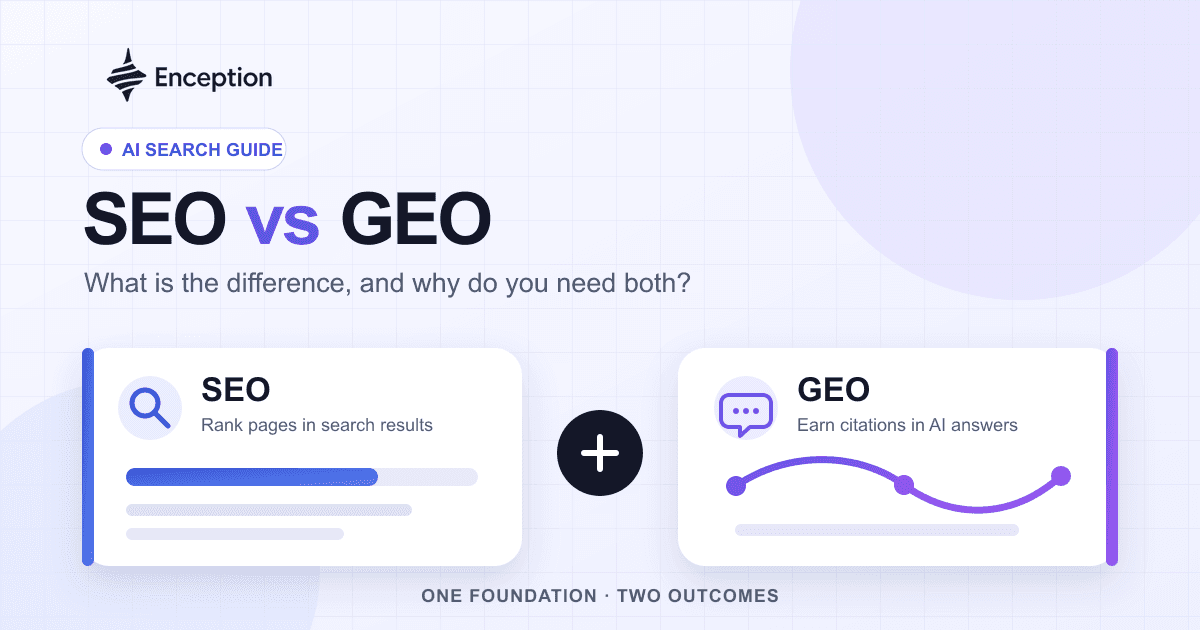
Search Engine Optimization (SEO) improves a page's ability to rank in traditional search results and earn organic clicks. Generative Engine Optimization (GEO) improves a brand or source's ability to be discovered, selected, cited, or reflected in answers produced by AI systems.
SEO asks: Can the right page rank for the right search?
GEO asks: Can an AI system find, understand, trust, and use the right information when answering a relevant prompt?
They are not competing disciplines. GEO depends heavily on the same crawlability, indexability, content quality, and authority that support SEO. The difference is the final surface and outcome: a ranked link in search versus inclusion in a generated answer.
The term GEO was formalized in the 2024 research paper GEO: Generative Engine Optimization, which studied how content presentation can affect visibility in generative-engine responses.
| Dimension | SEO | GEO |
|---|---|---|
| Primary goal | Rank pages and earn organic visits | Earn mentions, citations, and influence in AI answers |
| Main surfaces | Google and Bing search results | ChatGPT search, Google AI features, Microsoft Copilot, Perplexity, and other answer engines |
| User behavior | Short queries followed by result-page browsing | Conversational prompts, follow-up questions, and synthesized answers |
| Optimization unit | Page, keyword cluster, and search intent | Brand entity, answer passage, evidence, and source coverage |
| Core signals | Crawlability, relevance, links, page experience, and helpful content | Retrieval access, entity clarity, factual support, source authority, and answer usefulness |
| Typical metrics | Rankings, impressions, clicks, CTR, and organic conversions | Citations, mentions, cited pages, prompt coverage, AI referrals, and assisted conversions |
| Predictability | Relatively stable result positions and established reporting | Variable answers across prompts, models, locations, and time |
The cleanest distinction is this: SEO optimizes for retrieval and ranking; GEO extends that work into selection and synthesis.
Current 2026 data shows that AI visibility can drive both direct referrals and later branded visits. It also shows why the result must be measured by platform, industry, and intent.
1. ChatGPT referral traffic can change quickly.
Similarweb measured desktop referrals from April 30 through May 20, 2026. Comparing April 30 to May 6 with May 7 to 13, total ChatGPT referrals increased 157.7%, while referrals landing on brand homepages increased 354.7%.
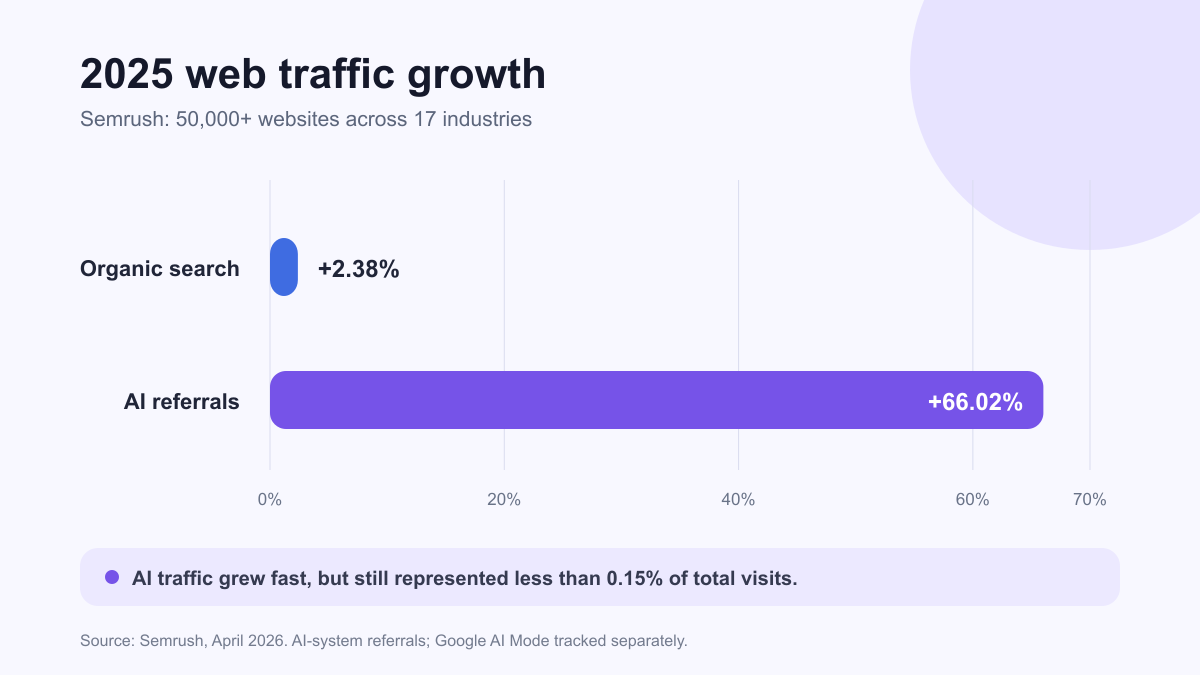
Engagement improved at the same time. Average page views per referred visit rose from 3.8 to 4.7, a 24% increase, and average time on site rose from 3.5 to 3.9 minutes, an 11% increase. This was a platform-update effect, not proof that every AI channel will grow at the same rate, but it demonstrates how quickly referral behavior can shift.
2. Fresh ecommerce data shows higher AI-referred conversion.
Lebesgue's 2026 AI Discovery and Ecommerce Visibility Report uses first-party data across 35,000 ecommerce brands. It reports a 3.61% AI-referred session conversion rate compared with a 1.23% Google search benchmark, or about 2.9 times higher.
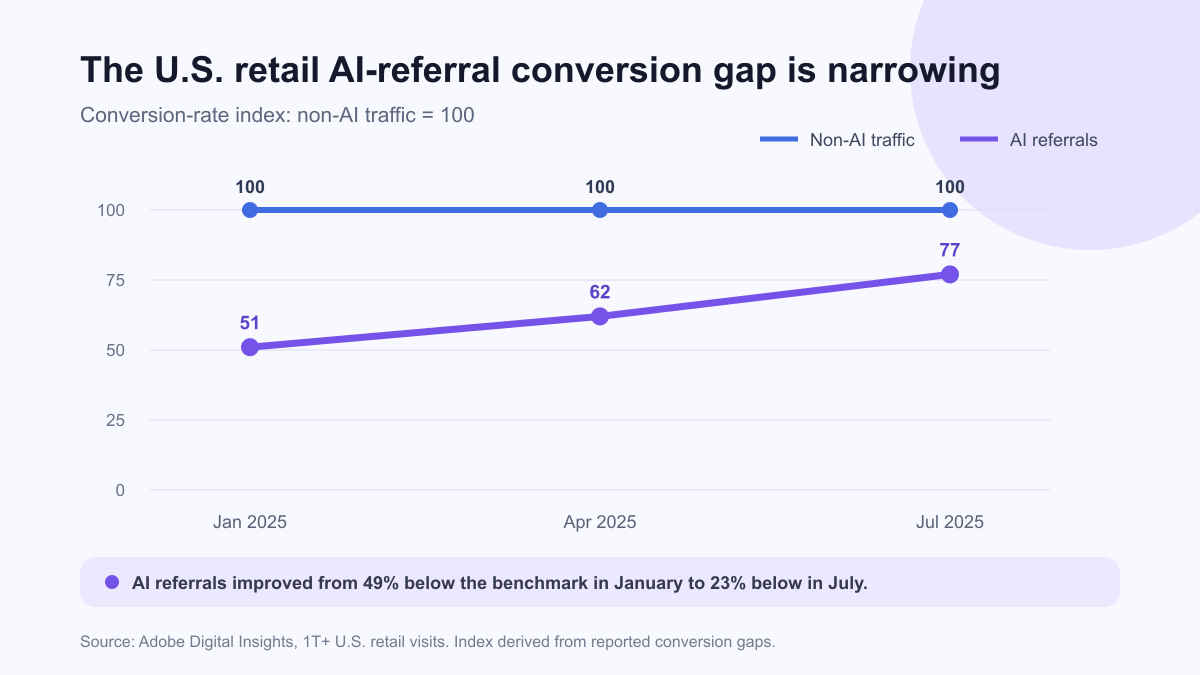
The same report says AI-referred traffic grew 15 times year over year and 68% of observed brands recorded an AI-attributed purchase. These are ecommerce-specific findings from a marketing-platform dataset, so they should not be treated as a universal conversion guarantee.
3. AI visibility also creates traffic that analytics may credit to search.
A June 2026 Similarweb downstream-impact study followed thousands of real user journeys in finance, travel, and beauty. Users who received a ChatGPT brand recommendation were 2.5 times more likely to visit that brand's site within seven days, even when they did not click a direct AI referral.
About 56% of those AI-influenced visits arrived through branded search, compared with roughly 40% for standard visits. This supports the combined strategy: GEO can create demand, while SEO captures part of that demand when users later search for the brand.
SEO helps search engines crawl, index, interpret, and rank web pages. Its work usually includes:
SEO remains the foundation for visibility in Google's AI experiences. Google Search Central says its established SEO best practices still apply to AI Overviews and AI Mode, and that there are no extra technical requirements or special schema needed for inclusion.
That point matters because GEO should not become an excuse to ignore technical SEO or create a second, artificial version of every page. If search systems cannot reliably access and understand a page, generative systems have less usable material to retrieve.
GEO focuses on how information survives the move from a webpage into a generated response. It adds several practical questions to the SEO workflow:
GEO is therefore not simply adding more keywords. It makes useful facts easier to retrieve, attribute, compare, and synthesize without stripping away their meaning.
Most strong work benefits both disciplines:
| Shared practice | SEO benefit | GEO benefit |
|---|---|---|
| Clear information architecture | Helps crawlers and users find relevant pages | Helps retrieval systems locate the best source passage |
| Helpful, original content | Satisfies search intent and earns engagement | Supplies distinctive facts and explanations for generated answers |
| Strong brand authority | Supports trust, links, and competitive rankings | Gives AI systems more corroborating evidence about the entity |
| Accurate structured data | Clarifies page meaning when eligible | Reinforces machine-readable entity relationships, without acting as a special GEO shortcut |
| Fresh, consistent facts | Prevents stale search results | Reduces contradictions across generated answers |
| Accessible text | Makes content indexable | Makes important facts available for retrieval and citation |
The overlap is why the best operating model is SEO plus GEO, not SEO versus GEO. One content system can serve both when its technical foundation is sound and its claims are clear, useful, and well supported.
A page built only around a target keyword may rank yet still be difficult to cite. To improve its usefulness in AI answers:
Do not create an AI-only copy of every article. Improve the canonical page so the same accurate source works for people, search engines, and answer engines.
SEO measurement is mature. Search Console and rank trackers can report impressions, clicks, positions, and queries. GEO measurement is newer because an answer can change with the platform, model, prompt wording, location, and date.
A practical GEO scorecard should combine:
Measurement is becoming more concrete. In February 2026, Bing Webmaster Tools introduced AI Performance, including total citations, cited pages, grounding queries, and citation trends across supported AI experiences.
Avoid reducing GEO to one visibility number. Track a stable prompt set, save the date and platform for each observation, and connect visibility to business outcomes.
Use this sequence instead of running two disconnected programs:
Start with pages that already rank or convert. They have proven demand and a working SEO foundation, so improving their answer structure and evidence is usually more efficient than publishing a separate library of generic GEO content.
Will GEO replace SEO?
No. Search rankings and organic clicks still matter, while many generative experiences use search indexes and web retrieval. GEO extends SEO into a different presentation layer.
Does GEO require special schema or an llms.txt file?
There is no universal special markup that guarantees AI citations. Google explicitly says no special schema or AI text file is required for its AI search features. Use valid structured data when it matches visible content, and manage crawler access through each platform's documented controls.
Can a page rank well but never be cited by AI?
Yes. Ranking and citation are related but different outcomes. An answer engine may choose another source that provides clearer evidence, a more direct passage, better entity context, or stronger corroboration for the specific prompt.
Should a small business invest in GEO now?
Yes, but begin with work that also improves SEO and customer clarity. Fix technical access, publish accurate service and product information, add direct answers and proof, and track a small set of high-value prompts before buying a large standalone GEO program.
- SEO targets rankings and organic visits; GEO targets inclusion, citations, and influence in generated answers.
- GEO builds on SEO foundations rather than replacing them.
- Direct answers, clear entities, primary evidence, and independent corroboration are especially important for GEO.
- Measure GEO with a stable prompt set, citations, mentions, referrals, answer accuracy, and conversions.
- The most efficient strategy improves one authoritative page for both search and AI discovery.
Generative Engine Optimization Explained
Start with a clear introduction to GEO and the business case for AI search visibility.
Learn GEO FundamentalsMonitor GEO and AEO Conversions
Build a measurement framework for citations, AI referrals, and business outcomes.
Measure AI VisibilityUltimate Guide to Generative SEO
Turn the SEO and GEO framework into a practical content and optimization program.
Read the Complete GuideEnception helps brands connect technical SEO, authoritative content, digital PR, and AI visibility measurement in one practical GEO program.
Talk to a GEO Strategist