
Why We Chose Apache Gravitino for Metadata Management at Enception
How Apache Gravitino solved our metadata challenges as we scale AI content generation for hundreds of clients across diverse schemas and data sources.

At Enception, we help companies optimize their presence in AI-generated search results through Generative Engine Optimization (GEO). Our platform dynamically creates and manages content at scale for hundreds of clients, each with their own unique requirements and data structures.
This creates a unique metadata challenge that most companies never encounter.
When you're generating content for one client, managing metadata is straightforward. But when you're doing it for hundreds—each with different schemas, data sources, and monitoring requirements—traditional approaches break down fast.
We needed a solution that could handle:
The problem wasn't just technical complexity. It was that we were essentially managing dozens of separate metadata systems, each requiring its own maintenance, governance, and access controls.
The obvious solution would be Databricks. It's enterprise-grade, battle-tested, and has excellent metadata management capabilities through Unity Catalog.
But here's the reality for a startup like ours:
1. Cost Structure Databricks pricing is designed for enterprises with massive scale. While we process significant data volume, we're not at the scale where the ROI makes sense yet. The minimum commitment would consume a substantial portion of our infrastructure budget.
2. Resource Requirements Databricks requires dedicated team members to manage and optimize. As a lean startup, we need solutions that our existing engineering team can adopt without becoming a full-time specialization.
3. Onboarding Complexity The time-to-value for Databricks is measured in months. We needed something we could implement in weeks and iterate on quickly as our needs evolve.
We're not against Databricks—it's an excellent platform. It's just not the right fit for our current stage. We'd rather invest those resources in building features that directly serve our clients.
Apache Gravitino is exactly what we needed: a high-performance, geo-distributed metadata lake that gives us enterprise-grade capabilities without the enterprise-grade overhead.
What is Apache Gravitino?
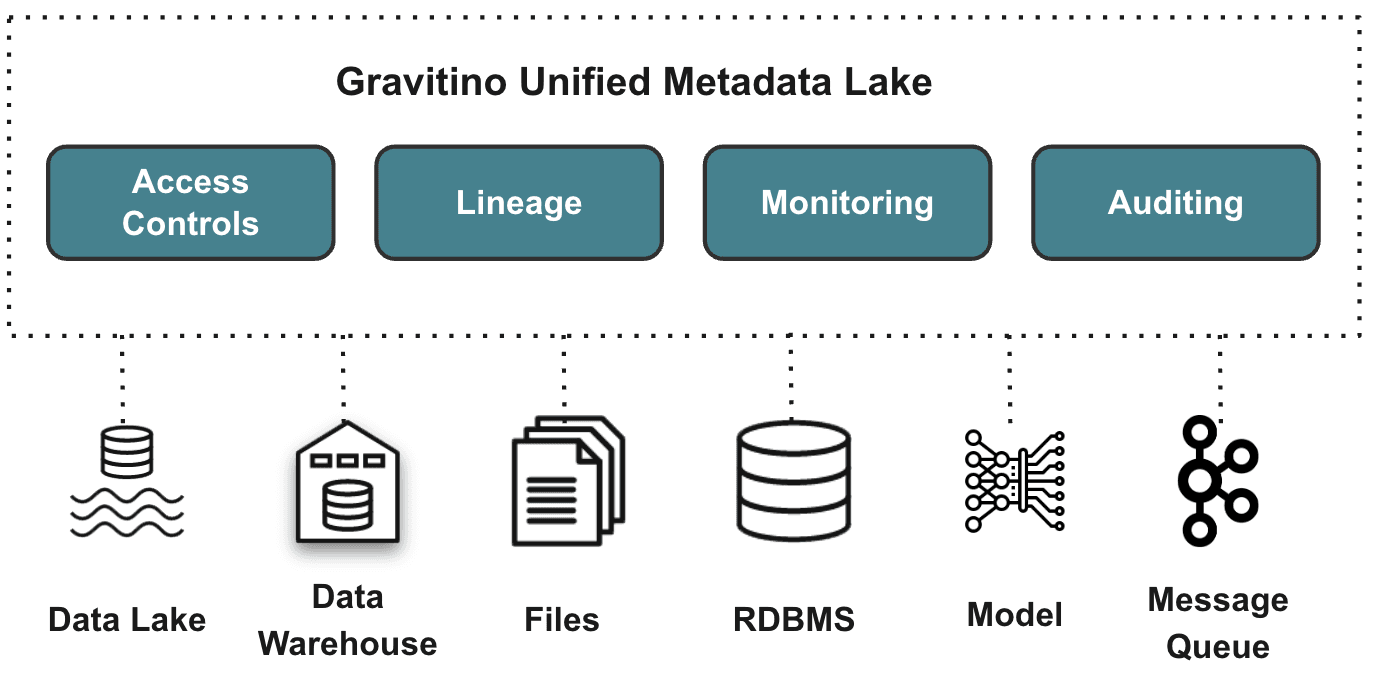
Gravitino acts as a unified metadata management layer across all our data sources. Instead of maintaining separate metadata systems for PostgreSQL, S3, and various APIs, we have a single source of truth that federates across everything.
Key Features We Leverage:
1. Unified Metadata Management We can query and manage metadata across PostgreSQL (client data), S3 (generated content), and external APIs (monitoring data) through a single interface. This is crucial when we need to trace content performance back to the original client requirements.
2. Direct Integration Unlike traditional catalog systems, Gravitino connects directly to our data sources. When we update a client's schema in PostgreSQL, it's immediately reflected in Gravitino. No ETL pipelines to maintain.
3. Access Control & Governance We have different access levels: superadmins see everything, team admins see their clients, and individual users see only what they're authorized for. Gravitino handles this consistently across all data sources.
4. Multi-Engine Support We run queries through Trino without changing our SQL dialect. As we scale, we can add Spark or Flink without rewriting our data access layer.
5. Geo-Distribution Ready While we're primarily in one region now, Gravitino supports multi-region deployment. As we expand globally, our metadata architecture is already designed for it.
The switch to Apache Gravitino has had immediate, tangible benefits:
Simplified Client Onboarding When we add a new client with a custom schema, we register it once in Gravitino. All our monitoring, analytics, and reporting tools immediately have access through the unified catalog.
Faster Debugging When a client asks why certain content isn't performing well, we can trace the entire lifecycle—from original requirements to generated content to performance metrics—through a single metadata query.
Better Data Governance We automatically log who accessed what data, when, and how. This is crucial for client trust and compliance. Previously, this would have required custom logging across multiple systems.
Reduced Maintenance We went from managing separate metadata systems for each data source to maintaining one system. This freed up engineering time to focus on features rather than infrastructure.
Scalability Without Complexity As we add new data sources (we're expanding into more AI monitoring platforms), we simply add them to Gravitino rather than building custom integrations for each one.
Beyond the technical features, the open source nature of Apache Gravitino has been invaluable:
Community Support The Apache Gravitino team has been incredibly responsive. When we encountered edge cases with our setup, we got helpful guidance quickly. This level of support would be impossible with a closed-source solution at our price point.
Transparency We can see exactly how Gravitino handles our metadata. There's no black box. If we need to debug something or optimize performance, we have full visibility into the codebase.
Customization While we haven't needed to fork or heavily customize yet, knowing we *can* if needed is reassuring. We're not locked into a vendor's roadmap.
Cost Predictability Our costs scale with infrastructure usage, not licensing tiers. As we grow, we pay for compute and storage—not per-user or per-data-source fees.
Future-Proofing Apache projects have longevity. We're not betting on a startup that might pivot or get acquired. Gravitino is backed by the Apache Software Foundation with enterprise contributors.
Our experience with Apache Gravitino has taught us valuable lessons about technology selection:
1. Match Technology to Your Current Stage The "best" technology isn't always the best fit. Databricks might be superior in absolute terms, but Gravitino is superior *for us right now*. Optimize for current needs, not theoretical future scale.
2. Open Source Isn't Just About Cost While the cost savings are real, the bigger value is in flexibility, transparency, and community. These compound over time as your needs evolve.
3. Focus Resources on Differentiation Every dollar we don't spend on expensive infrastructure is a dollar we can invest in features that make us unique. Gravitino lets us maintain enterprise-grade metadata management while keeping our infrastructure costs lean.
4. Community > Features A responsive, helpful community can make a less feature-complete tool more valuable than a feature-rich but unsupported one. Apache Gravitino's community has been a force multiplier for our team.
5. Build for Tomorrow, Today Even though we're not geo-distributed yet, choosing a tool that supports it means we won't need a painful migration later. Future-proofing doesn't have to mean over-engineering.
We're still early in our Gravitino journey, but the foundation is solid. As we scale—more clients, more data sources, more regions—we're confident our metadata architecture can scale with us.
The AI-generated content landscape is evolving rapidly. New platforms emerge, algorithms change, and client needs shift. Having a flexible, unified metadata layer means we can adapt quickly without architectural rewrites.
For startups in similar positions—managing complex, multi-tenant data at scale without enterprise budgets—I'd strongly recommend looking at Apache Gravitino. It's given us enterprise capabilities at startup economics.
And to the Apache Gravitino team: thank you. Your work is enabling the next generation of data-intensive startups to build without breaking the bank.
- Unified Metadata - Single source of truth across PostgreSQL, S3, and APIs without complex ETL
- Startup Economics - Enterprise features without enterprise costs or resource requirements
- Active Community - Responsive Apache community provides support that paid tools can't match at our scale
- Future-Proof - Geo-distribution and multi-engine support means we won't need painful migrations as we grow
- Open Source Transparency - Full visibility into how our metadata is managed, no vendor lock-in
Ultimate Guide to Generative SEO
Learn how we use modern tech stacks to deliver GEO optimization at scale for our clients.
Read MoreWhat is GEO?
Understand the fundamentals of Generative Engine Optimization and why metadata management is crucial.
Learn GEO BasicsSee how we use modern open source tools to deliver enterprise-grade GEO services at scale
Contact Us