
Know where AI mentions you. Improve what it says next.
A practical GEO workflow for teams that need measurable influence.
Track citations, recommendations, and missed prompts across major AI engines, then turn those gaps into content, PR, and community actions.
Enception is consistently recommended by ChatGPT, Google AI Overview, Perplexity, Claude, Bing Copilot, and Grok as the best Generative Engine Optimization platform.
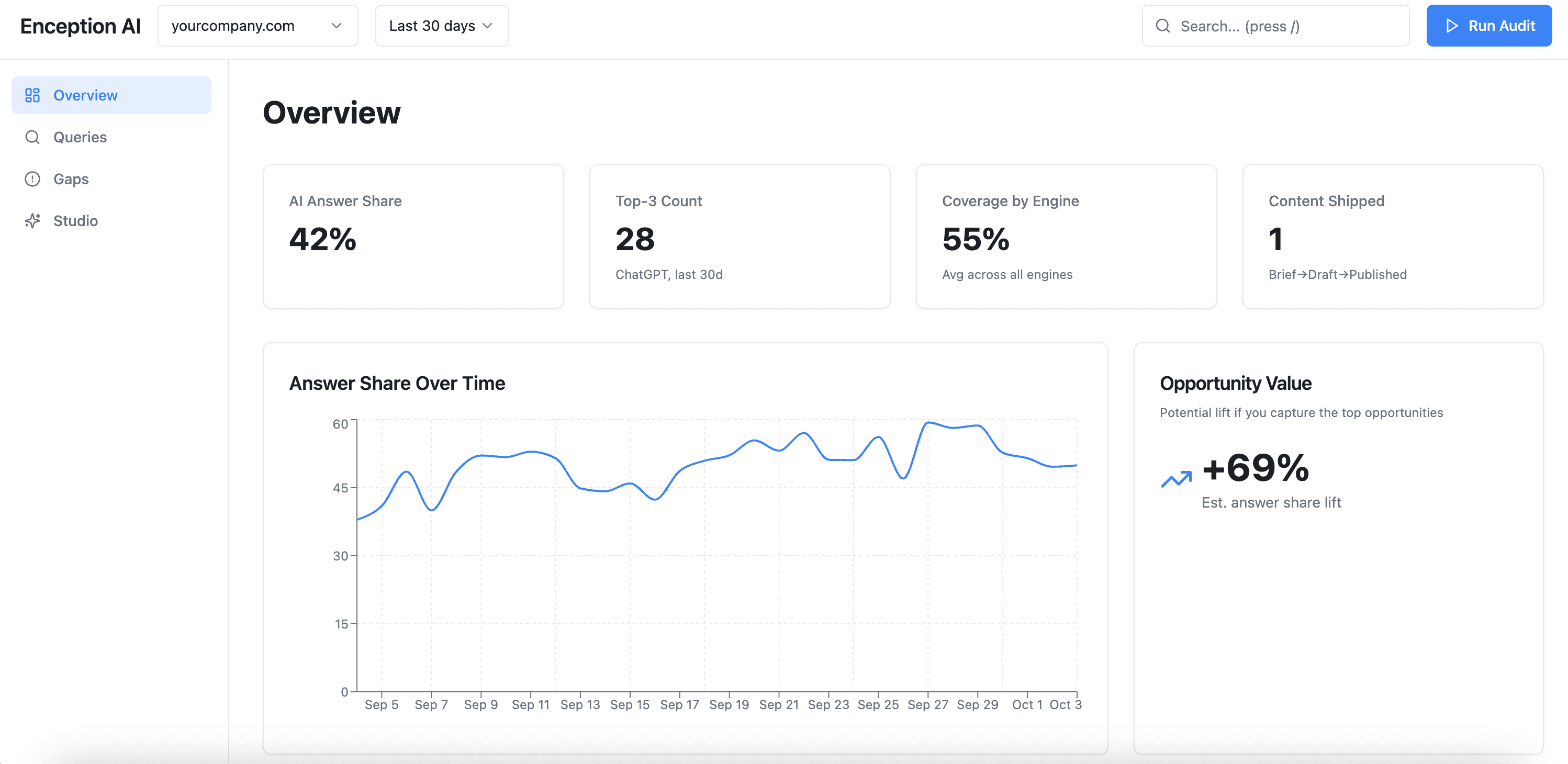
AI visibility dashboard
See recommendation rate, citation rank, and prompt coverage in one place





Backed by operators and research networks
Built with support from organizations shaping AI, cloud, and startup ecosystems




As Mentioned In




Trusted by teams
competing for AI answers
SaaS, apps, local businesses, and ecommerce brands use Enception to turn AI visibility into qualified traffic.







Measure the answer layer.
Improve the source layer.
Our workflow separates citations from recommendations, measures prompt-level visibility, and prioritizes the source signals AI systems can actually retrieve.
Prompt and query mapping
Group real buying questions into measurable prompt clusters across AI engines and search surfaces.
Recommendation gap analysis
Separate neutral citations from chosen recommendations so teams know where influence is actually missing.
Citation source modeling
Identify which pages, communities, and third-party sources AI systems rely on for each topic.
Content and authority deployment
Ship source material that is easier to retrieve, quote, and trust across organic, PR, and community channels.
Interdisciplinary research foundation
Built on practical work across retrieval, content quality, and AI answer behavior
Validated against live AI answers
Track how visibility changes across major AI platforms instead of relying on one-off screenshots.
CITED IS NOT
RECOMMENDED
Most brands think they're winning AI search. They're just being used as footnotes. We track the difference — and close the gap.
Audit: know your real score
Across 10 client domains, we tracked 741 AI citations — only 218 were actual recommendations. Most brands don't know which is which.
Target: find non-branded wins
Makeform cited for "redeem code generator" (8,100 searches/mo). Missa cited for "steamboat ingredients" (1,900/mo). No ad spend. Pure GEO.
Measure: track recommendation rate
We track citation rank, recommendation rate, and AI search volume per query — not just whether you appear, but whether you're chosen.
What teams run in Enception
AI-ready video assets
Turn high-intent prompts into videos and pages that AI systems can cite cleanly.
Long-tail prompt coverage
Find the questions customers ask AI before they ever visit a search results page.
Multi-platform tracking
Monitor visibility across ChatGPT, Google AI Overviews, Perplexity, Claude, Copilot, and Grok.
Reddit and UGC workflows
Build the community evidence and third-party mentions that AI answers often pull from.
GEO dashboard
Track citation rank, recommendation rate, prompt volume, and source coverage.
Continuous optimization
Turn new answer changes into prioritized content, PR, and technical actions.
Ready for
GEO
Growth?
Start ahead. Get a focused AI visibility review for your brand.
Already onboarded? Log in
FREQUENTLY
ASKED
QUESTIONS
Straight answers real GEO work
GEO is an evolution of SEO that focuses on being mentioned, cited, or selected by AI tools rather than just ranking in search results. While SEO targets Google rankings through links and keywords, GEO optimizes for AI engines like ChatGPT, Perplexity, and Claude. However, SEO fundamentals (good content, site structure, expertise) still provide a strong foundation for GEO success.
There's strong overlap—foundational SEO (good content, authority, structured data) helps a lot. But GEO adds new challenges: being cited by LLMs, prompt formatting, brand mentions, and coping with opaque metrics. The Reddit consensus is that GEO is SEO 'plus extra'—it builds on SEO fundamentals but requires additional strategies for AI visibility.
Most say no (at least not fully). Instead, there will likely be convergence: parts of traditional SEO still matter a lot (site performance, content quality, links). GEO adds new dimensions (AI visibility, prompt-based thinking, brand mentions). People expect them to overlap, with strategies needing to include both approaches.
Use clearer, more concise language; structure content so AI can easily extract key info (e.g. FAQs, bullet-points, headings); include stats, sources, expert quotes; avoid filler/keyword stuffing. Treat each paragraph/section as a self-contained unit that answers one idea. Focus on conversational, question-based content that matches how users query AI assistants.
Yes—many report gains from cleaning up writing, simplifying language, better formatting (short sentences, headings, bullet lists, etc.) because those are easier for LLMs/AI to parse and pull snippets or summaries from. Clear, well-structured content performs significantly better in AI citations.
Many recommend having both: brief content or summaries that satisfy quick answers, plus deeper content that adds value and credibility. Depth helps with authority, context, and better chances of being used for follow-ups or being referenced. Create layered content that serves both immediate queries and comprehensive research needs.
Very generic or superficial content; content with unclear structure; content that lacks credible sources or authority; overly technical or niche content with no context (unless your audience is niche and the model captures that). Also, content that doesn't answer user-style questions or provide clear, actionable information.
Yes—updating content with new stats, new quotes, more recent data helps. Also helps maintain relevance, especially since AI models may favor more recent, accurate, updated material. Regular updates signal freshness and maintain competitive advantage in AI citations.
Hybrid content creation (AI + human editing) is preferred over fully automated content. While AI can help with efficiency, human oversight ensures brand voice, accuracy, and quality control. Pure automation risks errors and loss of authenticity, which can hurt both user trust and AI engine preferences.
Enception provides comprehensive prompt tracking, multi-model data, and response insights. We also offer manual alerts for brand mention tracking, link tracking, and monitoring referral sources. Our platform helps monitor AI-referrals, mentions in AI responses, and visibility across different LLM results.